


RESOURCES / BLOG / GROWTH & ANALYTICS
Saves and Shares: Two Signals Stronger Than a Like
Contents
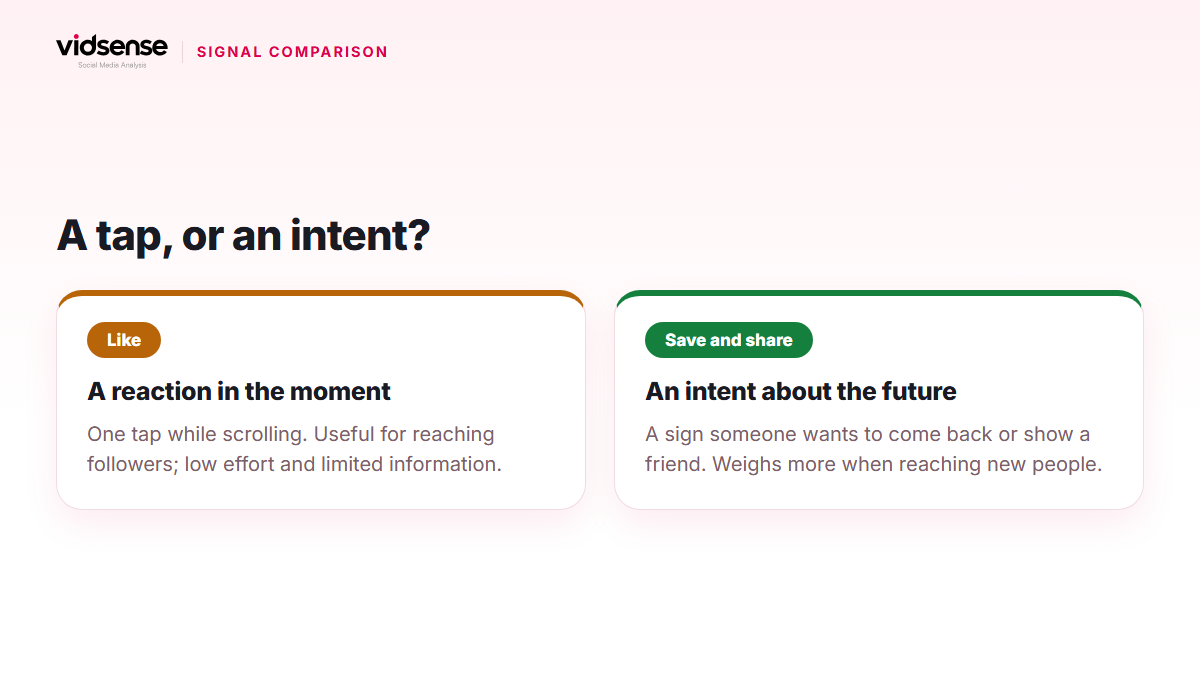
A like is a reaction; a save or a share is an intent
A like is a reflex you give while scrolling: low effort, and not much information. A save says "I'll come back to this." A share says "someone needs to see this." Both take the post out of the feed and put it somewhere that lasts, either in a personal collection or in a conversation.
This isn't just a reading of user psychology. Instagram's own ranking explainer lists how quickly people are liking, commenting, sharing and saving a post among the signals it uses, and for Reels it names "how likely you are to reshare a reel" as one of the most important predictions.
What Instagram has actually said
There are three official statements worth keeping apart:
- The ranking explainer (about.instagram.com, 2023): for Feed and Explore, the number and speed of likes, comments, shares and saves are among the signals, and Explore weights them more heavily than Feed does.
- The creators FAQ (creators.instagram.com): to decide how much distribution a piece of content gets, the most important input is engagement per viewer, including watch time, sharing, following, liking, commenting and profile visits.
- Adam Mosseri's January 2025 video: the three most important metrics are watch time, likes per reach and sends per reach. Likes matter slightly more for people who already follow you; sends matter slightly more for reaching people who don't.
What Meta has not published is the weighting. Claims like "a share is worth X times a like" are not official numbers, and Instagram has not described a separate weight for saves beyond counting them as interactions.
Think per reach, not in totals
The "per reach" part of Mosseri's phrasing is the part most accounts skip. As an example only: a post with 100 shares that reached 100,000 people has a share rate of 0.1%; the same 100 shares on a post that reached 5,000 people is 2%. The second post carries a far stronger signal even though the raw number is identical.
Post insights show likes, comments, saves and shares separately under "Interactions," with reach on the same screen. Divide saves and shares by reach for every post and you have two ratios you can rank your content by.
How to build something worth saving
A save comes from the feeling "I'll need this later." The formats that reliably produce it:
- Reference lists: steps, checklists, ingredient lists, comparisons.
- Actionable instructions: a method concrete enough to screenshot and keep.
- One-frame summaries: a long topic condensed into a single readable image.
- Time-bound information: dates, schedules, calendars, anything people come back to.
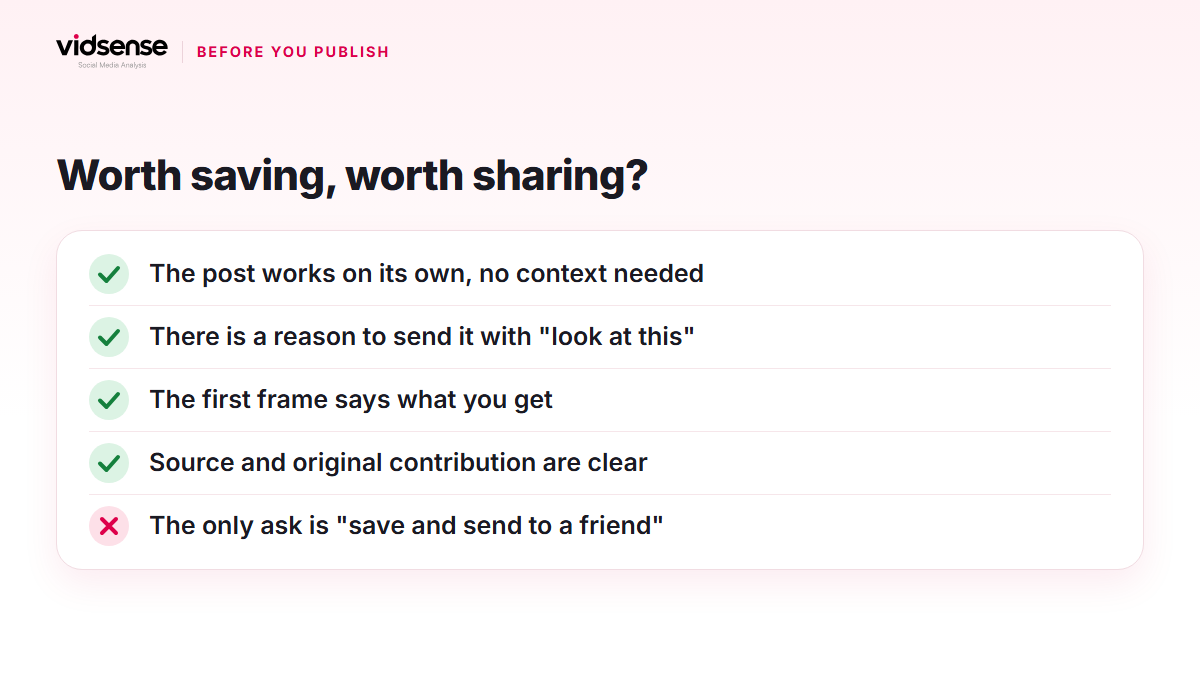
The common thread is that the post has to work on its own. When someone opens their saved items three weeks later, they shouldn't need to remember the context.
How to build something worth sharing
A share comes from the feeling "I have to show this to someone." People don't really share the post; they share what they're going to say to their friend alongside it:
- Content that describes a person: "people who can't work before coffee," "anyone who just moved house."
- A question or claim that starts a conversation: the recipient should feel a need to respond.
- Information that solves a shared problem for a team, a family or a group.
- An emotional payoff: a laugh, or a "this is exactly it."
The thing to watch here is giving a reason to share rather than asking for the share. Writing "save this and send it to a friend" in the caption edges toward engagement bait; the intent should come from the content itself. Instagram's recommendation guidelines also note that practices meant to artificially drive engagement can make content ineligible for recommendation.
How to measure it
Rank your last 10 to 20 posts by saves per reach and shares per reach. Look at what the top three to five have in common: the format, the topic, the first line? Then repeat that element deliberately in your next three posts and compare. Don't draw conclusions from a single post, and compare formats within themselves, because Reels, carousels and single images have different distribution dynamics.
Check it with VidSense
Saves and shares are measured after you publish, but you can raise the odds of earning them before. VidSense checks your post or reel ahead of time and shows you the opening, the structure and any risk signals in one place. Create a free account and run your first check from the dashboard; the free plan includes two content checks a month.
Source: Instagram's ranking explainer at about.instagram.com, the creators FAQ at creators.instagram.com, Adam Mosseri's ranking video at instagram.com/mosseri, post insights at help.instagram.com, and the recommendation guidelines at help.instagram.com.
Contents
Check your content before you post it.
Use Content Check to see potential risk signals before you publish.
Check your content →Keep reading
Growth & Analytics · 5 min read
Do Instagram Hashtags Still Work? Realistic Expectations
According to Instagram's own statements, hashtags are a category and search signal, not a distribution engine. This guide covers what to expect from them, relevance over quantity, the current limits, and how to check for restricted hashtags.
October 15, 2026
Growth & Analytics · 4 min read
Posting Time and Consistency: Building Your Own Rhythm
A consistent posting rhythm matters more than finding a perfect hour. This guide shows how to test and build a sustainable schedule using your own data.
October 6, 2026
Growth & Analytics · 4 min read
How to Calculate Your Instagram Engagement Rate
Engagement rate can be calculated against followers or reach. This guide covers both methods, what affects the number, and what it does and doesn't reveal about your content.
September 30, 2026