RESOURCES / BLOG / POLICY
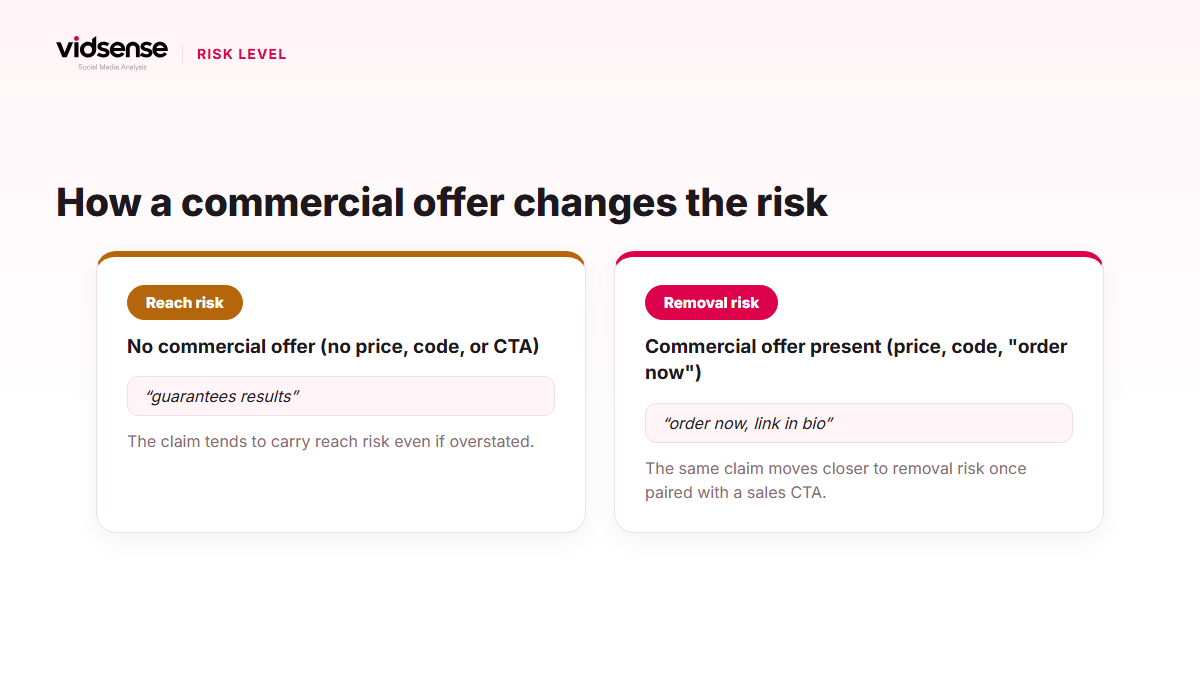
Instagram treats commercial guaranteed-result claims and unverified health claims as sensitive, both under its Community Standards and its recommendation guidelines. A phrase doesn't need a banned word to be risky: patterns like "guaranteed," "miracle," or "100% works" paired with a commercial offer (a price, a code, "order now") can carry removal risk; the same wording without an offer tends to carry reach risk instead.
"Lose 10kg in a week, guaranteed" or "this product guarantees results" reads as risky, especially combined with a sales call to action.
"Cures," "prevents disease," "replaces medication" — claims like these, made without stating any scientific basis, can carry both platform and legal risk (health-claim regulation applies in Turkey specifically, and similar consumer-protection rules exist in most markets).
"Get rich fast," "works 100% of the time," "works for everyone" — sweeping, absolute claims deserve a second look; patterns like these can read as a fabricated-promise signal.
Balanced, transparent language is both more trustworthy and lower risk: "results vary from person to person," "this is my personal experience, not a guarantee," "consult a professional" all carry the same message in a more careful frame. The line between sharing a personal story and making a blanket promise accounts for most of the risk difference.
Check your content before you post it.
Use Content Check to see potential risk signals before you publish.
The same claim shifts risk tier when it's paired with a sales call to action (a price, a discount code, "order via DM"). Without a commercial element, the claim tends to be a reach-risk issue; with one, it moves closer to removal risk. That distinction explains why the same sentence can be read two different ways.
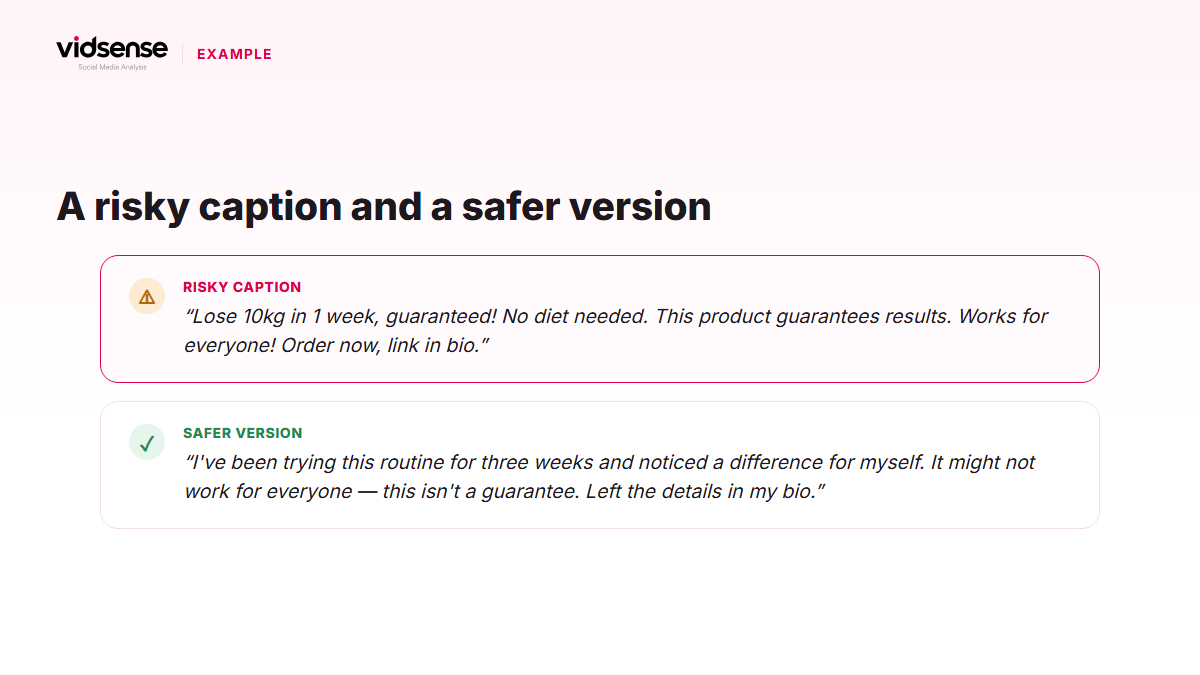
Risky caption: "🔥 Lose 10kg in 1 week, guaranteed! No diet, no exercise needed. This product burns fat fast and guarantees you'll slim down. Works for everyone, results are certain! Order now, link in bio." This single caption stacks a guaranteed-result claim, a health claim, and a sales call to action together — three separate risky elements in one sentence.
Safer version: "I've been trying this routine for three weeks and noticed a difference for myself. It might not work the same way for everyone — this isn't a guarantee, and diet and sleep matter a lot too. Left the product details in my bio for anyone curious." Same product, but the claim is grounded in personal experience, the absolute language is gone, and the reader is left to make their own call.
Is sharing a personal story always safe? Mostly, but not on its own. If a personal experience gets combined with a generalized claim — "it worked for me, so it's guaranteed to work for you" — the risk can come right back. What keeps it safe is staying within the personal frame and being explicit that the result isn't guaranteed to generalize.
VidSense's text and content check flags this kind of language before you publish and suggests a safer alternative. Remember: a VidSense risk signal is not an official platform decision — it's a suggestion to review. Create a free account to use the text check and, for videos or images, the content check.